Abstract
The adoption of Climate Smart Agriculture (CSA) practices could help smallholder farmers in Ethiopia enhance food security and appropriately manage climate change impacts. Conservation agricultural practice is intended to conserve, improve and make more efficient use of natural resources. However, despite these potential benefits, CSA is only practiced in some areas of Ethiopia and has not been sufficiently adopted by smallholder farmers. Therefore, this experiment was intended to improve the production and productivity of maize through different moisture conservation practices and to determine and recommend the best moisture conservation practices for agro-pastoralists in Yabello District, Borana Zone. The field experiment was conducted at Qobo, Qadale and Colksa Kebeles of Yabello districts for two consecutive years, from 2019 to 2020, the main cropping seasons. The experiments had four treatments (Runoff diversion, Furrow, Runoff diversion plus Furrow and Control) laid out in a randomized complete block design (RCBD) of three replications. The analysis of variance showed that there was a significant difference among treatments in days to maturity, cob diameter, cob length, hundred seed weight and grain yield in all cropping seasons and locations. The highest grain yield was obtained from furrow with diversion structure treatment (5.83, 5.59, 4.2 t/ha), followed by diversion structure (5.51, 4.84, 3.9 t/ha) at Qadale, Colkasa and Qobo Kebeles, respectively. The lowest grain yield was recorded for the control (farmers practice) treatment (3.56, 3.05 and 3.36 ton/ha) at Qadale, Colkasa and Qobo Kebeles, respectively. In all sites, moisture conservation treatments (furrow plus diversion, diversion and furrow) have yield advantages of 2.27 t/ha (40.68%), 2.54 t/ha (45.44%), 0.84 t/ha (20%), 1.95 t/ha (35.39%), 1.79 t/ha (36.98%), 0.54 t/ha (13.84%) and 1.88 t/ha (34.55%), 2.02 t/ha (39.84%) and 0.36 t/ha (9.43%) more than farmer’s practices, respectively. Therefore, moisture conservation practices are recommended for optimum production of maize in moisture stress areas of Yabello District, Borana Zone.
Keywords
Conservation Agriculture, Furrow, Run off Diversion, Yield
1. Introduction
Agriculture is the backbone of the Ethiopian economy and it contributes about 50% of the country’s gross domestic product (GDP) and more than 80% of its exports
| [1] | Temesgen, M., Hoogmoed, W. B., Rockstrom, J. and Savenije, H. H. G. Conservation Tillage Implements and Systems for Smallholder Farmers in Semi-Arid Ethiopia. Soil Tillage Res. 2009, 104(1), 185–191. |
| [2] | Stellmacher, T. and Kelboro, G. Family Farms, Agricultural Productivity, and the Terrain of Food (In)Security in Ethiopia. Sustainability. 2019, 11, 4981. |
[1, 2]
. Furthermore, it is one of the main employment sectors with about 80% of the country's population depending on the agricultural sector for their livelihoods
| [3] | Njeru, E., Grey, S. and Kilawe, E. Eastern Africa Climate-Smart Agriculture Scoping Study: Ethiopia, Kenya and Uganda; FAO: Addis Ababa, Ethiopia. 2016. |
[3]
. However, the yield of crops on these farms is being impeded by several issues, such as severe drought and high rainfall attributed to climate change. Additionally, unpredictable floods and recurrent droughts are among the other factors that hinder the transformation of dry lands into productive environments, consequently leading to a fragile ecosystem
| [4] | Ahmad, M. M., Yaseen, M., and Saqib, S. E. Climate change impacts of drought on the livelihood of dryland smallholders: Implications of adaptation challenges. International Journal of Disaster Risk Reduction. 2022, 80, 103210. |
[4].
Globally, Climate Smart Agriculture (CSA) has been recognized as a suitable solution to overcome the challenges of food security and climate change impacts on agriculture especially in vulnerable areas
| [5] | Bai, X., Huang, Y., Ren, W., Coyne, M., Jacinthe, P., Tao, B., Hui, D., Yang, J. and Matocha, C. Responses of Soil Carbon Sequestration to Climate-smart Agriculture Practices: A Meta-analysis. Global Change Biology. 2019, 25, 2591–2606. |
[5]
. Thus, the adoption of CSA practices could help smallholder farming in Ethiopia to enhance food security and appropriately manage climate change impacts
| [6] | Agegnehu, G. and Tilahun, T. Integrated Soil Fertility and Plant Nutrient Management in Tropical Agro-Ecosystems: A Review. Pedosphere. 2017, 27, 662–680. |
| [7] | Wassie, A. and Pauline, N. Evaluating Smallholder Farmers’ Preferences for Climate Smart Agricultural Practices in Tehuledere District, Northeastern Ethiopia: Evaluating Smallholder Farmers’ Preferences. Singapore Journal of Tropical Geography. 2018, 39, 300–316. |
[6, 7]
. However, despite these potential benefits CSA is only practiced in some areas of Ethiopia and has not been sufficiently adopted by smallholder farmers
| [7] | Wassie, A. and Pauline, N. Evaluating Smallholder Farmers’ Preferences for Climate Smart Agricultural Practices in Tehuledere District, Northeastern Ethiopia: Evaluating Smallholder Farmers’ Preferences. Singapore Journal of Tropical Geography. 2018, 39, 300–316. |
[7]
. This is partly attributed to available labor, knowledge and level of education
| [8] | Jirata, M., Grey, S. and Kilawe, E. Ethiopia Climate-Smart Agriculture Scoping Study; FAO: Addis Ababa, Ethiopia. 2016. |
| [9] | Aweke, M. G. Climate-Smart Agriculture in Ethiopia: CSA Country Profiles for Africa Series. International Center for Tropical Agriculture: Washington, DC, USA. 2017. |
[8, 9]
. Although Ethiopia’s agriculture has enjoyed increasing governmental support over the years
| [10] | Welteji, D. A. Critical Review of Rural Development Policy of Ethiopia: Access, Utilization and Coverage. Agricultural Food Security. 2018, 7, 55. |
[10]
. especially land tenure policy and financial and price support schemes are described as being insufficient or ineffective.
To improve dry land agricultural production adopting in-situ rainwater harvesting has greater potential to effectively conserve adequate soil moisture
| [11] | Manyatsi AM, Mhazo N, Mkhatshwa M and Masarirambi MT. The Effect of Different in-situ Water Conservation Tillage Methods on Growth and Development of Taro (Colocasia esculenta L.). 2011, 11-18. |
[11]
. It is an important strategy to increase infiltration and storage of water in soil and reduce the effects of drought stress on maize grain yield
| [12] | Mudatenguha F, Anena J, Kiptum CK and Mashingaidze AB. In situ rain water harvesting techniques increases maize growth and grain yield in a semi-arid agro-ecology of Nyagatare, Rwanda. International Journal of Agricultural Biology. 2014, 16, 996-1000. |
[12]
. The idea of in situ moisture conservation is to make appropriate use of runoff or harvested rainwater during times of drought. This is particularly true in semi-arid and arid areas, where rainfall is erratic and water is a scarce resource for agriculture
| [13] | Yosef, B. A., and Asmamaw, D. K. Rainwater harvesting: An option for dry land agriculture in arid and semi-arid Ethiopia. International Journal of Water Resources and Environmental Engineering. 2015, 7(2), 17-28. |
[13]
. A number of agronomic practices such as mulching, ridging, manuring, and other small farm structures such as field ridges/bunds, contour bunds, bench terraces within cropped area and others, could fall under in situ moisture conservation category
| [14] | Desta L, Carucci V, Wendem-Ageňehu A and Abebe Y. Community Based Participatory Watershed Development: A Guideline. Ministry of Agriculture and Rural Development, Addis Ababa, Ethiopia. 2005. |
[14]
. According to Milkias et al.
in-situ water harvesting techniques such as furrow ridges, tied ridges and contour ridges improve soil moisture stored within the root zone, improve the agronomic components and produce higher grain yields
| [15] | Milkias, A., Tadesse, T., and Zeleke, H. Evaluating the effects of in-situ rainwater harvesting techniques on soil moisture conservation and grain yield of maize (Zea mays L.) in Fedis district, Eastern Hararghe, Ethiopia. Turkish Journal of Agriculture-Food Science and Technology. 2018, 6(9), 1129-1133. |
[15]
. Besides, in-situ moisture conservation practices are important to improve crop yields by enhancing soil moisture, conserving rain water and controlling erosion
| [16] | Mekuria W., Noble A., McCartney M., Hoanh CT. and Douangsavanh S. Soil management for raising crop water productivity in rainfed production systems in Lao PDR. Archives of Agronomy and Soil Science. 2016, 62, 53-68. |
[16]
. Addressing the problem of moisture stress requires means of supplying additional water for crops to meet their Evapo-transpiration demand with the help of either irrigation or on-farm water harvesting techniques.
Borana pastoral and agropastoral Communitys are dependent of rainfall for water resources, both in domestic and livestock watering. To protect its livelihoods, enhancing resilience of agriculture to climate risk is paramount. Therefore, climate smart agriculture such as the adoption of conservation agriculture incorporating in rangeland management, which includes different innovative technologies, is able to contribute towards the improvement of food security, improve the productivity of the dryland ecosystem of Borana Rangeland and maintain the stability of the environment. Therefore, the objectives of the study were to improve the production and productivity of Maize under different soil moisture conservation structures and to determine and recommend best moisture conservation practice for agro-pastoralists of Borana Zone.
2. Materials and Methods
2.1. Description of the Study Area
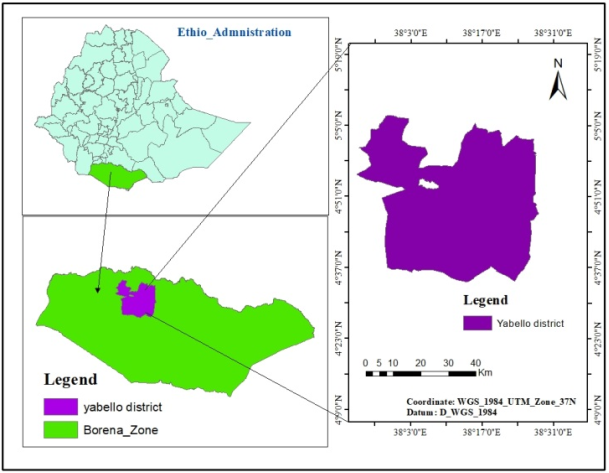
The study was conducted at moisture stress areas of Borana zone of yabello District during a main cropping season for testing adoption and introduction to conservation agriculture on grain yield of maize (Mekasa-1 variety). Three peasant associations (Qobo, Qadale and Colkasa) were purposively selected from Yaballo District where moisture stress is the primary problem for crop production. Yabello is located at 570km from south of Addis Ababa, Ethiopia. Its altitude varies from 1000 to 1800 meter above sea level (masl) at the latitude and longitudes of 5°0´0´´– 5°23´0´´ N and 38°2´0´´ – 38°15´0´´ E, respectively (Coppock, 1994).
2.2. Experimental Design and Management
For this study the treatments used were: runoff diversion, furrowing, runoff diversion+ furrowing and control treatments. The treatments were designed in RCBD with three site replication. The furrow structure was constructed with 1m spacing and 30cm deep ripping and the Diversion was constructed in trapezoidal channel width of 0,5 m, depth of 1 m and at 1% slope of bottom width of runoff structures on standard maize plot was design for the treatment. Each entry was planted in a plot having 6 rows of 5.5 m length. Four rows were harvested and two border rows were left to exclude border effect. The row and plant spacing was kept at 40 cm and 10 cm, respectively. Individual plot size was 5.5 m × 5 m = 27.5 m2 and 1.5 m and 2 m between plot and block, respectively. 100 kg NPS/ha and 100 kg urea/ha Fertilizers were applied at the time of planting. All other agronomic managements were applied uniformly in all experimental plots, as per national recommendation for the crop.
Figure 1. Location map of the study area.
The data on yield attributes and biological yield were collected from all treatments equally. Plot base collected data were: days to physiological maturity and grain yield. Plant base collected data were hundred seed weight, plant height, Ear height, Ear length and Ear diameter.
(i) Cob diameter (cm): The length of five randomly selected cobs from each of the five randomly selected plants was measured at harvesting and the average was used.
(ii) Cob length (cm): The length of the maize cob, which is the central stalk of the maize plant on which the kernels grow of five randomly selected cobs and the average was used.
(iii) Days to physiological maturity: The number of days from emergency to the date when 90% of the plant in each plot are physiologically matured determined by the formation of black layer at the base of each kernel.
(iv) Thousand seed weight (g): After shelling, random kernels from the bulk of each plot were counted using a photoelectric seed counter and weighed in grams after the moisture was adjusted to 12.5%.
(v) Grain yield (kg ha-1): grain yield per plot was measured using electronic balance and then adjusted to 12.5% moisture and converted to a hectare basis.
Analysis of variance (ANOVA) was computed for grain yield and other traits as per the methods described by Gomez and Gomez
| [17] | Gomez, K. A. and Gomez, A. A. Statistical procedures for agricultural research. 2nd ed. New York, USA.: John Willey and Sons Ltd: 1984, p. 680. |
[17]
using SAS computer software (Version 9) for Randomized Complete Block Design. Comparison of treatment means was made using Duncan Multiple Range test (DMRT) at 5% level of significance.
ANOVA modelXij= µ+Ti+Bj+Eij(1)
Where, Xij = Observed value, µ = general mean, Ti = effect of treatments, Bj = effect of replication (block), Eij = residual effects or experimental error
3. Results and Discussions
3.1. Effect of In-Situ Soil and Water Conservation Structures on Soil Moisture Content
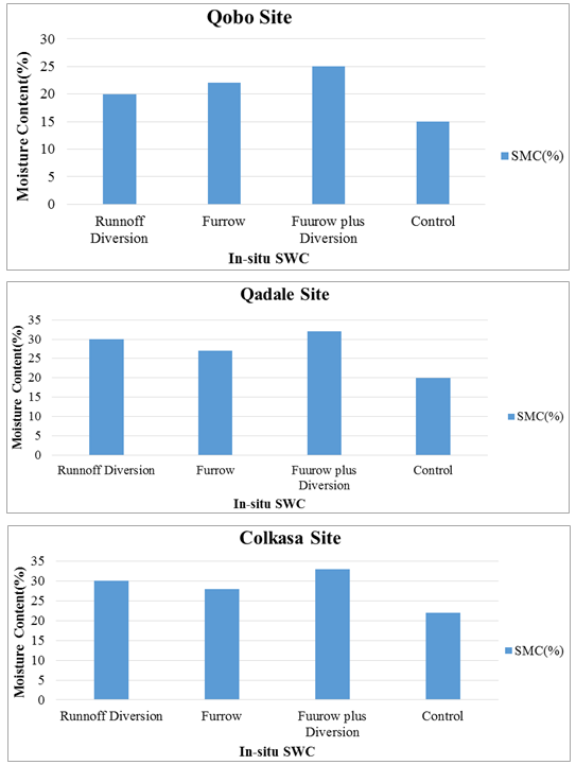
The effects of in-situ soil and water conservation structures on soil moisture content at Qobo, Qadale and Colkasa Kebeles during first and second cropping seasons are shown in
Figure 2. The in-situ moisture conservation showed that high soil moisture content was recorded from the furrow plus diversion and furrow alone, with mean values of 25% and 22% respectively, at Qobo site during the first cropping season. However, low soil moisture was recorded from control and diversion with mean values of 15% and 20%. In this season (2019) high erratic rainfall was occurred, which causes dry spells. Due to this the soil moisture content was very low compared to the second season. Besides, in the second cropping season (2020) the result of moisture content (%) at Qadale site shows that high soil moisture content was recorded from furrow plus diversion and diversion with mean values of 32 and 30 while low soil moisture was recorded from control with mean values of 20%. In similar manner, at Colkasa site high moisture content (%) was obtained from furrow plus diversion and diversion with mean value of 33% and 30%, while low moisture was recorded from the control one with mean value of 22%. This finding was in line with the findings of Ayalaa et al. and Mudatenguha et al. who found that in-situ moisture conservation can improve soil moisture storage, extend the period that moisture is available, enhance crop growth, and increase economic production
| [18] | Ayalaa, G., Geremua, T., Ararsob, E., and Bultia, A. Evaluation of In-situ water harvesting Structures on Soil Moisture, Yield and Yield Components of Sorghum in Moisture Deficit Areas of Daro Lebu and Boke districts. 2019. |
| [12] | Mudatenguha F, Anena J, Kiptum CK and Mashingaidze AB. In situ rain water harvesting techniques increases maize growth and grain yield in a semi-arid agro-ecology of Nyagatare, Rwanda. International Journal of Agricultural Biology. 2014, 16, 996-1000. |
[18, 12]
. Additionally, Milkias et al. stated that water collected in the channels feeds the soil until it reaches the impermeable layer, at which point it begins to flow laterally or upward, developing a reservoir of water for the crop at a depth in which, on clay or heavy-textured soils, it rises through capillarity during dry spells to ensure the crop's benefits
| [15] | Milkias, A., Tadesse, T., and Zeleke, H. Evaluating the effects of in-situ rainwater harvesting techniques on soil moisture conservation and grain yield of maize (Zea mays L.) in Fedis district, Eastern Hararghe, Ethiopia. Turkish Journal of Agriculture-Food Science and Technology. 2018, 6(9), 1129-1133. |
[15].
Figure 2. The effect of in-situ Soil and Water conservation structures on soil moisture content (%) at three locations between 2019 and 2020.
3.2. Effect of In-Situ Soil and Water Conservation Structures on Yield and Yield Component of Maize Production
3.2.1. Phenology and Growth Traits
The findings from the initial year of the study, conducted in 2019, revealed that the furrowing plus diversion of the structures exhibited the best performance in relation to both yield and yield components. Conversely, the maize yield was observed to be the lowest under the control treatment. These results suggest that conservation agriculture may hold significant promise for enhancing maize yield in regions characterized by moisture stress, such as the Yabello District. Besides, the results of analysis of variance (ANOVA) reveals that there was a significant difference (P < 0.05) among treatments on maturity date, cob diameter and cob length among in-situ moisture conservation practices during 2019 and 2020 cropping season at both locations.
Table 1. Mean performance value of Maize under different moisture conservation structures during main cropping season of 2019 at Qobo site.
Treatments | MD (day) | CD (cm) | CL (cm) | HSW (gm) | Grain yield (t/ha) |
Diversion | 113.3ab | 4.44a | 15.60 a | 27.5 a | 3.90ab |
Furrowing | 112 ab | 4.35b | 15.24 a | 28.17 a | 3.71 ab |
Furrowing +Diversion | 114 a | 4.40 a | 15.50 a | 28.8 a | 4.21 a |
Control | 110 b | 4.10 c | 13.86 b | 26.8 a | 3.36 b |
LSD | 1.98 | 0.15 | 1.13 | 2.59 | 0.28 |
CV | 1.38 | 1.86 | 3.99 | 9.16 | 7.81 |
Table 2. Mean performance value of Maize during main cropping season of 2020 at Qadale site.
Treatments | MD (day) | CD (cm) | CL (cm) | HSW (gm) | Grain yield (t/ha) |
Diversion | 115 ab | 4.49a | 15.87a | 31.53a | 5.51a |
Furrowing | 112 b | 4.34b | 14.80ab | 31.93a | 5.44a |
Furrowing +Diversion | 116 a | 4.49a | 15.27ab | 33.50a | 5.83a |
Control | 111 c | 4.13c | 14.20b | 27.13b | 3.56b |
LSD | 0.92 | 0.137 | 1.28 | 3.2977 | 0.87 |
CV | 1.81 | 1.66 | 4.51 | 5.65 | 9.12 |
Table 3. Mean performance value of Maize during main cropping season of 2020 at Colkasa site.
Treatments | MD (days) | CD (cm) | CL (cm) | HSW (gm) | Grain yield (t/ha) |
Diversion | 114.2 | 4.39a | 15.33a | 26.00a | 4.84a |
Furrowing | 112 | 4.35a | 15.67a | 28.0ab | 5.07a |
Furrowing +Diversion | 115 | 4.30a | 15.73a | 29.0ab | 5.59a |
Control | 110.5 | 4.07b | 13.47b | 25.66b | 3.05b |
LSD | 1.45 | 0.165 | 0.9844 | 3.17 | 1.49 |
CV | 1.60 | 2.05 | 3.47 | 6.196 | 17.12 |
Days to maturity of Maize among different moisture structures was ranged from 110 to 114, with a mean of 112.3 days to maturity at Qobo site. Among them, furrow plus diversion structure was late to attain maturity (114 days) and control (without any structure) (110) of the treatments attained days to maturity earlier than the others (
table 1). Similarly, the results from Qadale (
table 2) and Colkasa (
table 3) indicate that maize harvested early came from the control (farmers practice), while maize that matured later was obtained from the furrow plus diversion structure. This indicates that late-maturing crops can extend the growing season, allowing for a longer period of photosynthesis and potential yield accumulation.
Analysis of variance showed that a significance difference among different soil moisture conserving structures (p<0.05) in cob diameter. The information indicates that the furrow plus diversion soil moisture conservation structures resulted in the highest cob diameter compared to all other structures at the Qobo, Qadale, and Colkasa sites, with average diameters of 4.4, 4.49, and 4.39 cm, respectively. On the other hand, the control group (farmer practice) had the smallest cob diameter with average measurements of 4.1, 4.13, and 4.07 cm at the Qobo, Qadale, and Colkasa sites, respectively. This indicate that, the use of different soil moisture conservation structures led to plants producing cobs with larger diameters compared to those grown on flat bed (farmer’s practices). In line with the current finding, Ayalaa et al. observed significant differences among in-situ moisture conserving structures in growth traits of sorghum crop at the moisture deficit area of Daro lebu and Boke districts
| [18] | Ayalaa, G., Geremua, T., Ararsob, E., and Bultia, A. Evaluation of In-situ water harvesting Structures on Soil Moisture, Yield and Yield Components of Sorghum in Moisture Deficit Areas of Daro Lebu and Boke districts. 2019. |
[18]
.
The effect of in-situ moisture structures on cob length was presented in
Tables 1, 2 and 3, at p<0.05, the cob diameter has shown significant difference between treatments with in-situ moisture conserving structures and control (without any structure). Among the given soil moisture conservation structures, diversion showed highest cob length than all other structures, while control (farmer practice) showed lowest cob diameter at both Qobo and Qadale sites. However, in Colkasa site, Furrow plus diversion had the longest cob length than other treatments.
3.2.2. Post Harvested Data
(i). Hundred Seed Weight (gm)
The analysis of variance revealed no significant difference among various soil moisture structures (p<0.05) in terms of hundred seed weight in 2019 and 2020 across all locations. However, the control treatment (farmer practice) consistently exhibited the lowest hundred seed weight compared to the other structures. This indicates, that the effect of in-situ moisture structure enhances the productivity of the Maize crop over traditional farming methods (control), that result in lower hundred seed weights.
(ii). Grain Yield (ton/ha)
Analysis of variance showed significance differences among different soil moisture structures (p<0.05). Furrow plus diversion soil moisture conservation structures showed highest grain yield than all other structures, while control (farmer practice) showed lowest grain yield. The result indicated that diversion and furrowing plus diversion of water treatment was best in terms of yield. This may indicate that conservation agriculture has a promising contribution for improving Maize yield in moisture stress areas like Yabello District. In general, the analysis of variance showed that there was significant difference among treatments in days to maturity, cob diameter, cob length, hundred seed weight and grain yield in all cropping seasons and locations. The highest grain yield was obtained from furrow with diversion structure treatment (5.83, 5.59, 4.2 ton/ha), followed by diversion structure (5.51, 4.84, 3.9 ton/ha) at Qadale, Colkasa and Qobo Kebeles respectively. The lowest grain yield was recorded from control (Farmers practice) treatment (3.56, 3.05, 3.36 ton/ha) at Qadale, Colkasa and Qobo Kebeles respectively. Moisture conservation treatments had 2. 27 t/ha (40.68%), 2.54 t/ha (45.44%), 0.84 t/ha (20%), 1.95 t/ha (35.39%), 1.79 t/ha (36.98%), 0.54 t/ha (13.84%) and 1.88 t/ha (34.55%), 2.02 t/ha (39.84%), 0.36 t/ha (9.43%) yield advantage over farmers practice for furrow plus diversion, diversion and furrow, respectively. In line with the present study the finding of Wolde et al. 2020 showed that In-situ moisture conservation measures (Targa) is the best solution to solve the soil moisture stress to enhance the maize productivity in dry land agriculture of Mirab Abaya Woreda, Southern, Ethiopia
| [19] | Wolde B., Naba W. and Gebremichael A. Evaluation of In-situ Moisture Conservation Techniques for Maize Production in Moisture Stress Areas of Mirab Abaya Woreda, Southern, Ethiopia. Advances in Crop Science and Technology. 2020, 8, 442. |
[19]
.
All treatments with in-situ soil moisture structure have performed much better than the controlled treatments. This might be due to the fact that the in-situ moisture conserving structures store rainwater, enhancing infiltration, which provide a reservoir of water to the crop at depth, where heavy textured soils (sandy clay), rises by capillarity during dry spells and ensure the crop benefits. This result is in agreement with the finding of Gebreyesus stated that, tied-ridge and fertilizer interaction significantly influenced the yield and yield components of sorghum and resulted in up to 48% increments
| [20] | Gebreyesus BT. Effect of Tillage and Fertilizer Practices on Sorghum Production in bergelle Area, Northern Ethiopia. Momona Ethiopian Journal of Science (MEJS). 2012, 4(2), 5269. |
[20].
4. Conclusions and Recommendation
Conservation agriculture in the moisture stress area improves the soil moisture rooting zone. This is due to improved soil infiltration rates, catches run off at the time of rainfall, which increased the grain yield of early maturing Maize in the study area. These structures were furrow, runoff diversion and their combinations. Generally, furrow, runoff diversion and a combination of furrow with diversion produced higher grain yields of maize than control (farmer's practices). The maximum mean grain yield was recorded from combination of furrow with runoff diversion than from they alone and farmers practices. This is due to soil moisture retention, preventing runoff and keeping rainwater as much as possible. Therefore, farmers of Yabello and similar agroecology areas, those with their farmland with steep slopes, should use furrow plus runoff diversion soil moisture conservation structures. Therefore, moisture conservation practice is recommended for optimum production of Maize in moisture stress areas of Borana Zone. Promotion of the technology should be done to improve agricultural production in similar agroecologys and Further, studies are required for detection of the effects of in-situ soil moisture conservation on soil erosion and water balance.
Abbreviations
RCBD: Randomized Complete Block Design
GDP: Gross Domestic Product
CSA: Climate Smart Agriculture
Masl: Meter Above Sea Level
ANOVA: Analysis of Variance
DMRT: Duncan Multiple Range Test
SWC: Soil and Water Conservation
MD: Maturity Date
CD: Cob Diameter
CL: Cob Length
HSW: Hundred Seed Weight
Acknowledgments
The authors express their gratitude to Oromia Agricultural Research Institution for financial support and appreciate the staff of Yabello Pastoral and Dry Land Agriculture Research Centers for helping and facilitating the fieldwork activities. The authors also gratefully appreciate the Pastoralists and Agro-pastoralists of the study area for supporting us during the course of the study. I provide special thanks for Mr. Ibsa Jibat and Balda Edao, cereal crop researchers, for their contribution in data collection during field work.
Author Contributions
Fenan Tola: Budget Acquisition, Data curation, Software, Formal Analysis, Supervision, Investigation, Writing - original draft, Methodology, Writing - review & editing
Isihak Lolo: Conceptualization, Data curation, Supervision, Investigation, Writing - original draft, Methodology
Conflicts of Interest
The authors declare no conflicts of interest.
References
| [1] |
Temesgen, M., Hoogmoed, W. B., Rockstrom, J. and Savenije, H. H. G. Conservation Tillage Implements and Systems for Smallholder Farmers in Semi-Arid Ethiopia. Soil Tillage Res. 2009, 104(1), 185–191.
|
| [2] |
Stellmacher, T. and Kelboro, G. Family Farms, Agricultural Productivity, and the Terrain of Food (In)Security in Ethiopia. Sustainability. 2019, 11, 4981.
|
| [3] |
Njeru, E., Grey, S. and Kilawe, E. Eastern Africa Climate-Smart Agriculture Scoping Study: Ethiopia, Kenya and Uganda; FAO: Addis Ababa, Ethiopia. 2016.
|
| [4] |
Ahmad, M. M., Yaseen, M., and Saqib, S. E. Climate change impacts of drought on the livelihood of dryland smallholders: Implications of adaptation challenges. International Journal of Disaster Risk Reduction. 2022, 80, 103210.
|
| [5] |
Bai, X., Huang, Y., Ren, W., Coyne, M., Jacinthe, P., Tao, B., Hui, D., Yang, J. and Matocha, C. Responses of Soil Carbon Sequestration to Climate-smart Agriculture Practices: A Meta-analysis. Global Change Biology. 2019, 25, 2591–2606.
|
| [6] |
Agegnehu, G. and Tilahun, T. Integrated Soil Fertility and Plant Nutrient Management in Tropical Agro-Ecosystems: A Review. Pedosphere. 2017, 27, 662–680.
|
| [7] |
Wassie, A. and Pauline, N. Evaluating Smallholder Farmers’ Preferences for Climate Smart Agricultural Practices in Tehuledere District, Northeastern Ethiopia: Evaluating Smallholder Farmers’ Preferences. Singapore Journal of Tropical Geography. 2018, 39, 300–316.
|
| [8] |
Jirata, M., Grey, S. and Kilawe, E. Ethiopia Climate-Smart Agriculture Scoping Study; FAO: Addis Ababa, Ethiopia. 2016.
|
| [9] |
Aweke, M. G. Climate-Smart Agriculture in Ethiopia: CSA Country Profiles for Africa Series. International Center for Tropical Agriculture: Washington, DC, USA. 2017.
|
| [10] |
Welteji, D. A. Critical Review of Rural Development Policy of Ethiopia: Access, Utilization and Coverage. Agricultural Food Security. 2018, 7, 55.
|
| [11] |
Manyatsi AM, Mhazo N, Mkhatshwa M and Masarirambi MT. The Effect of Different in-situ Water Conservation Tillage Methods on Growth and Development of Taro (Colocasia esculenta L.). 2011, 11-18.
|
| [12] |
Mudatenguha F, Anena J, Kiptum CK and Mashingaidze AB. In situ rain water harvesting techniques increases maize growth and grain yield in a semi-arid agro-ecology of Nyagatare, Rwanda. International Journal of Agricultural Biology. 2014, 16, 996-1000.
|
| [13] |
Yosef, B. A., and Asmamaw, D. K. Rainwater harvesting: An option for dry land agriculture in arid and semi-arid Ethiopia. International Journal of Water Resources and Environmental Engineering. 2015, 7(2), 17-28.
|
| [14] |
Desta L, Carucci V, Wendem-Ageňehu A and Abebe Y. Community Based Participatory Watershed Development: A Guideline. Ministry of Agriculture and Rural Development, Addis Ababa, Ethiopia. 2005.
|
| [15] |
Milkias, A., Tadesse, T., and Zeleke, H. Evaluating the effects of in-situ rainwater harvesting techniques on soil moisture conservation and grain yield of maize (Zea mays L.) in Fedis district, Eastern Hararghe, Ethiopia. Turkish Journal of Agriculture-Food Science and Technology. 2018, 6(9), 1129-1133.
|
| [16] |
Mekuria W., Noble A., McCartney M., Hoanh CT. and Douangsavanh S. Soil management for raising crop water productivity in rainfed production systems in Lao PDR. Archives of Agronomy and Soil Science. 2016, 62, 53-68.
|
| [17] |
Gomez, K. A. and Gomez, A. A. Statistical procedures for agricultural research. 2nd ed. New York, USA.: John Willey and Sons Ltd: 1984, p. 680.
|
| [18] |
Ayalaa, G., Geremua, T., Ararsob, E., and Bultia, A. Evaluation of In-situ water harvesting Structures on Soil Moisture, Yield and Yield Components of Sorghum in Moisture Deficit Areas of Daro Lebu and Boke districts. 2019.
|
| [19] |
Wolde B., Naba W. and Gebremichael A. Evaluation of In-situ Moisture Conservation Techniques for Maize Production in Moisture Stress Areas of Mirab Abaya Woreda, Southern, Ethiopia. Advances in Crop Science and Technology. 2020, 8, 442.
|
| [20] |
Gebreyesus BT. Effect of Tillage and Fertilizer Practices on Sorghum Production in bergelle Area, Northern Ethiopia. Momona Ethiopian Journal of Science (MEJS). 2012, 4(2), 5269.
|
Cite This Article
-
ACS Style
Tola, F.; Lolo, I. Introducing and Evaluation of Conservation Agriculture in Dry Land of Borana, Oromia, Southern Ethiopia. World J. Agric. Sci. Technol. 2024, 2(2), 46-53. doi: 10.11648/j.wjast.20240202.12
 Copy
|
Copy
|
 Download
-
@article{10.11648/j.wjast.20240202.12,
  author = {Fenan Tola and Isihak Lolo},
  title = {Introducing and Evaluation of Conservation Agriculture in Dry Land of Borana, Oromia, Southern Ethiopia},
  journal = {World Journal of Agricultural Science and Technology},
  volume = {2},
  number = {2},
  pages = {46-53},
  doi = {10.11648/j.wjast.20240202.12},
  url = {https://doi.org/10.11648/j.wjast.20240202.12},
  eprint = {https://article.sciencepublishinggroup.com/pdf/10.11648.j.wjast.20240202.12},
  abstract = {The adoption of Climate Smart Agriculture (CSA) practices could help smallholder farmers in Ethiopia enhance food security and appropriately manage climate change impacts. Conservation agricultural practice is intended to conserve, improve and make more efficient use of natural resources. However, despite these potential benefits, CSA is only practiced in some areas of Ethiopia and has not been sufficiently adopted by smallholder farmers. Therefore, this experiment was intended to improve the production and productivity of maize through different moisture conservation practices and to determine and recommend the best moisture conservation practices for agro-pastoralists in Yabello District, Borana Zone. The field experiment was conducted at Qobo, Qadale and Colksa Kebeles of Yabello districts for two consecutive years, from 2019 to 2020, the main cropping seasons. The experiments had four treatments (Runoff diversion, Furrow, Runoff diversion plus Furrow and Control) laid out in a randomized complete block design (RCBD) of three replications. The analysis of variance showed that there was a significant difference among treatments in days to maturity, cob diameter, cob length, hundred seed weight and grain yield in all cropping seasons and locations. The highest grain yield was obtained from furrow with diversion structure treatment (5.83, 5.59, 4.2 t/ha), followed by diversion structure (5.51, 4.84, 3.9 t/ha) at Qadale, Colkasa and Qobo Kebeles, respectively. The lowest grain yield was recorded for the control (farmers practice) treatment (3.56, 3.05 and 3.36 ton/ha) at Qadale, Colkasa and Qobo Kebeles, respectively. In all sites, moisture conservation treatments (furrow plus diversion, diversion and furrow) have yield advantages of 2.27 t/ha (40.68%), 2.54 t/ha (45.44%), 0.84 t/ha (20%), 1.95 t/ha (35.39%), 1.79 t/ha (36.98%), 0.54 t/ha (13.84%) and 1.88 t/ha (34.55%), 2.02 t/ha (39.84%) and 0.36 t/ha (9.43%) more than farmer’s practices, respectively. Therefore, moisture conservation practices are recommended for optimum production of maize in moisture stress areas of Yabello District, Borana Zone.},
 year = {2024}
}
Copy
|
Download
-
TY  - JOUR
T1  - Introducing and Evaluation of Conservation Agriculture in Dry Land of Borana, Oromia, Southern Ethiopia
AU  - Fenan Tola
AU  - Isihak Lolo
Y1  - 2024/05/17
PY  - 2024
N1  - https://doi.org/10.11648/j.wjast.20240202.12
DO  - 10.11648/j.wjast.20240202.12
T2  - World Journal of Agricultural Science and Technology
JF  - World Journal of Agricultural Science and Technology
JO  - World Journal of Agricultural Science and Technology
SP  - 46
EP  - 53
PB  - Science Publishing Group
SN  - 2994-7332
UR  - https://doi.org/10.11648/j.wjast.20240202.12
AB  - The adoption of Climate Smart Agriculture (CSA) practices could help smallholder farmers in Ethiopia enhance food security and appropriately manage climate change impacts. Conservation agricultural practice is intended to conserve, improve and make more efficient use of natural resources. However, despite these potential benefits, CSA is only practiced in some areas of Ethiopia and has not been sufficiently adopted by smallholder farmers. Therefore, this experiment was intended to improve the production and productivity of maize through different moisture conservation practices and to determine and recommend the best moisture conservation practices for agro-pastoralists in Yabello District, Borana Zone. The field experiment was conducted at Qobo, Qadale and Colksa Kebeles of Yabello districts for two consecutive years, from 2019 to 2020, the main cropping seasons. The experiments had four treatments (Runoff diversion, Furrow, Runoff diversion plus Furrow and Control) laid out in a randomized complete block design (RCBD) of three replications. The analysis of variance showed that there was a significant difference among treatments in days to maturity, cob diameter, cob length, hundred seed weight and grain yield in all cropping seasons and locations. The highest grain yield was obtained from furrow with diversion structure treatment (5.83, 5.59, 4.2 t/ha), followed by diversion structure (5.51, 4.84, 3.9 t/ha) at Qadale, Colkasa and Qobo Kebeles, respectively. The lowest grain yield was recorded for the control (farmers practice) treatment (3.56, 3.05 and 3.36 ton/ha) at Qadale, Colkasa and Qobo Kebeles, respectively. In all sites, moisture conservation treatments (furrow plus diversion, diversion and furrow) have yield advantages of 2.27 t/ha (40.68%), 2.54 t/ha (45.44%), 0.84 t/ha (20%), 1.95 t/ha (35.39%), 1.79 t/ha (36.98%), 0.54 t/ha (13.84%) and 1.88 t/ha (34.55%), 2.02 t/ha (39.84%) and 0.36 t/ha (9.43%) more than farmer’s practices, respectively. Therefore, moisture conservation practices are recommended for optimum production of maize in moisture stress areas of Yabello District, Borana Zone.
VL  - 2
IS  - 2
ER  -
Copy
|
Download





 Share This Article
 Twitter
 Linked In
 Facebook