
The growing scarcity of freshwater resources presents a major challenge to rice production particularly in irrigation systems that rely on limited freshwater supplies. Enhancing the water use efficiency has therefore become essential for sustainable rice cultivation. This study evaluated the rice crop water productivity under continuous flooding irrigation regime using the Ahero Irrigation Scheme in Kenya as a case study. The rice crop water productivity was determined as the ratio of the total mass of rice production to the total volume of water supplied for irrigation. The rice crop water productivity for the scheme was measured and found to be 0.3406 kgm-3. The measured value was lower than what is commonly achieved under improved irrigation regimes such as intermittent irrigation. The low water productivity was mainly attributed to conveyance losses along the earthen canals and application losses due to inefficient irrigation practices. Improving the water productivity requires several interventions; lining and maintenances of canals to reduce conveyance losses, adopting intermittent irrigation to use less irrigation water resource, training farmers on proper land preparation techniques to enhance leveling in the irrigation basins thereby reducing excessive irrigation water application in unleveled basins, and strengthening the capacity of Irrigation Water Users Associations to monitor and enforce proper irrigation water usage.
| Published in | World Journal of Agricultural Science and Technology (Volume 3, Issue 4) |
| DOI | 10.11648/j.wjast.20250304.12 |
| Page(s) | 112-121 |
| Creative Commons |
This is an Open Access article, distributed under the terms of the Creative Commons Attribution 4.0 International License (http://creativecommons.org/licenses/by/4.0/), which permits unrestricted use, distribution and reproduction in any medium or format, provided the original work is properly cited. |
| Copyright |
Copyright © The Author(s), 2025. Published by Science Publishing Group |
Rice Crop Water Productivity, Crop Water Productivity, Water Productivity, Water Use Efficiency, Continuous Flooding Irrigation, Application Losses, Conveyance Losses
Months | Production (Kg) |
|---|---|
Apr 2022 | 1,167,878 |
May 2022 | 516,878 |
Jun 2022 | 0 |
Jul 2022 | 179,200 |
Aug 2022 | 328,200 |
Sep 2022 | 226,800 |
Oct 2022 | 1,397,600 |
Nov 2022 | 322,000 |
Dec 2022 | 0 |
Jan 2023 | 867,370 |
Feb 2023 | 561,730 |
Mar 2023 | 189,300 |
Total | 5,756,956 |
Pump Name | Discharge Rate (m3/s) | Duration (Hrs) | Volume of Pumped Water (m3) |
|---|---|---|---|
Pump 1 | 0.3492 | 3769 | 4,738,085.28 |
Pump 2 | 0.5287 | 3743 | 7,124,126.76 |
Pump 3 | 0.425 | 0 | 0 |
Pump 4 | 0.291 | 1953 | 2,045,962.80 |
Total | 13,908,174.84 | ||
Months | Depth of monthly rainfall (mm) | Depth of effective rainfall (mm) | Cropped area in (m2) | Volume effective rainfall (m3) |
|---|---|---|---|---|
Apr 2022 | 182.6 | 129.3 | 1,833,225.77 | 237,036.09 |
May 2022 | 119.4 | 96.6 | 2,986,579.73 | 288,503.60 |
Jun 2022 | 105 | 87.4 | 3,642,170.40 | 318,325.69 |
Jul 2022 | 29.5 | 28.1 | 5,070,710.57 | 142,486.97 |
Aug 2022 | 69.1 | 61.5 | 6,495,203.88 | 399,455.04 |
Sept 2022 | 97.9 | 82.6 | 6,470,922.74 | 534,498.22 |
Oct 2022 | 28.9 | 27.6 | 5,317,568.78 | 146,764.90 |
Nov 2022 | 121.7 | 98 | 4,661,978.11 | 456,873.85 |
Dec 2022 | 115.5 | 94.2 | 3,763,576.08 | 354,528.87 |
Jan 2023 | 16.3 | 15.9 | 2,339,082.77 | 37,191.42 |
Feb 2023 | 6.1 | 6 | 530,138.14 | 3,180.83 |
Mar 2023 | 218.6 | 142.1 | 530,138.14 | 75,332.63 |
Total | 2,994,177.10 | |||
AWD | Alternate Wetting and Drying |
CWP | Crop Water Productivity |
Mc | Mass of Crop Production |
Vp | Volume of Pumped Irrigation Water |
Vr | Volume of Water as Effective Rainfall |
Vs | Volume of Water Supplied |
WUAs | Water Users Associations |
| [1] | United Nations. World Population Prospects 2022: Summary of Results. Department of Economic and Social Affairs, Population Division, UN DESA/POP/2022/TR/No. 3; 2022. |
| [2] | United Nations. Transforming Our World: The 2030 Agenda for Sustainable Development. United Nations General Assembly, A/RES/70/1; 2015. |
| [3] | GRiSP. Rice Almanac: Source Book for One of the Most Important Economic Activities on Earth, 4th ed. Global Rice Science Partnership: International Rice Research Institute (IRRI); 2013. |
| [4] | FAO. Rice Market Monitor: Volume XIX - Issue No. 1. Food and Agriculture Organization (FAO) of the United Nations; 2016. |
| [5] | Bouman, B. How much water does rice use? Rice Today: Management. 2009, 69(2), 115-133. |
| [6] | Tuong, T., Bouman, B. A. M. Rice production in water-scarce environments. In Water Productivity in Agriculture: Limits and Opportunities for Improvement. CABI Publishing; 2003, pp. 53-67. |
| [7] | FAO. Coping with Water Scarcity: An Action Framework for Agriculture and Food Security. Food and Agriculture Organization (FAO) of the United Nations; 2011. |
| [8] | Ali, M. H., Talukder, M. Increasing water productivity in crop production—A synthesis. Agricultural Water Management. 2008, 95(11), 1201-1213. |
| [9] | Molden, D., Oweis, T., Steduto, P., Bindraban, P., Hanjra, M. A., Kijne, J. Improving agricultural water productivity: Between optimism and caution. Agricultural Water Management. 2010, 97(4), 528-535. |
| [10] | Zwart, S. J., Bastiaanssen, W. G. Review of measured crop water productivity values for irrigated wheat, rice, cotton and maize. Agricultural Water Management. 2004, 69(2), 115-133. |
| [11] | Chaudhari, S. S., Sudhishiri, S., Khanna, M., Dass, A., Rosin, K., Bhattacharya, R., Maurya, R. Water budgeting in major rabi crops under surface irrigation in Western Indo-Gangetic Plains. Indian Journal of Agricultural Sciences. 2020, 90(11), 2185-2191. |
| [12] | Raviraj, A., Ramachandran, J., Kaushal, N., Mishra, A. Simple water balance model and crop water demand at different spatial and temporal scales in Periya Pallam catchment of upper Bhavani basin, Tamilnadu. Environment Conservation Journal. 2021, 22(3), 217-224. |
| [13] | Bokke, A. S., Shoro, K. E. Impact of effective rainfall on net irrigation water requirement: The case of Ethiopia. Water Science. 2020, 34(1), 155-163. |
| [14] | Mallareddy, M., Thirumalaikumar, R., Balasubramanian, P., Naseeruddin, R., Nithya, N., Mariadoss, A., Eazhilkrishna, N., Choudhary, A. K., Deiveegan, M., Subramanian, E., Padmaja, B., Vijayakumar, S. Maximizing water use efficiency in rice farming: A comprehensive review of innovative irrigation management technologies. Water. 2023, 15(10), 1802. |
| [15] | Mboyerwa, P. A., Kibret, K., Mtakwa, P., Aschalew, A. Evaluation of growth, yield, and water productivity of paddy rice with water-saving irrigation and optimization of nitrogen fertilization. Agronomy. 2021, 11(8), 1629. |
| [16] | Dou, F., Soriano, J., Tabien, R. E., Chen, K. Soil texture and cultivar effects on rice (Oryza sativa L.) grain yield, yield components and water productivity in three water regimes. PLoS ONE. 2016, 11(3), e0150549. |
| [17] | Johnson, J.-M., Becker, M., Kaboré, J. E., Dossou-Yovo, E. R., Saito, K. Alternate wetting and drying: A water-saving technology for sustainable rice production in Burkina Faso? Nutrient Cycling in Agroecosystems. 2024, 129, 93-111. |
| [18] | Biswal, P., Swain, D. K., Jha, M. K., Mohan, G., Matsuda, H. Development of irrigation regime of limited and unlimited water supply for satisfactory rice yield. Agricultural & Food Science Journal. 2021, 58(1), 28. |
| [19] | Akhter, M., Ali, M., Mahmood, A., Saleem, U. Comparison of yield and water productivity of rice (Oryza sativa L.) hybrids in response to transplanting dates and crop maturity durations in irrigated environment. Irrigation & Drainage Systems Engineering. 2017, 6(1), 180. |
| [20] | Wang, F., Liu, Y., Zhang, A., Kong, D., Bi, J., Liu, G., Yu, X., Luo, L. Breeding an early maturing, blast-resistant, water-saving and drought-resistant rice (WDR) cultivar using marker-assisted selection coupled with rapid generation advance. Plants. 2022, 42(8), 46. |
| [21] | Algarni, S. M., Elshekh, M. E., Agiza, A. M., Nassar, F. S. Analyzing the impact of climate change on rice production and strategies for enhancing efficiency, sustainability, and global food security. International Journal of Innovative Research and Scientific Studies. 2025, 8(2). |
| [22] | Bwire, D., Saito, H., Mugisha, M., Nabunya, V. Water productivity and harvest index response of paddy rice with alternate wetting and drying practice for adaptation to climate change. Water. 2022, 14(21), 3368. |
| [23] | Carrijo, D. R., Lundy, M. E., Linquist, B. A. Rice yields and water use under alternate wetting and drying irrigation: A meta-analysis. Field Crops Research. 2017, 203, 173-180. |
| [24] | Pinto, V. M., Reis, A. F., de Melo, M. L., Reichardt, K., Santos, D., Lier, Q. D. J. V. Sustainable irrigation management in tropical lowland rice in Brazil. Agricultural Water Management. 2023, 284, 108345. |
| [25] | Howell, T. A. Irrigation efficiency. In Encyclopedia of Water Science. United States Department of Agriculture (USDA), Bushland, Texas, USA; 2015, pp. 467-471. |
| [26] | Marita, N. K., Kipkorir, E. C., Kibiiy, J., Ooro, C. Hydraulic performance evaluation of irrigation and drainage infrastructure serving Ahero Irrigation Scheme in Kenya. Hydrology. 2025, 13(2), 126-133. |
| [27] | Irmak, S., Odhiambo, L. O., Kranz, W. L., Eisenhauer, D. E. Irrigation efficiency and uniformity, and crop water use efficiency. Biological Systems Engineering: Papers and Publications. 2011, 451, 1-8. |
| [28] | Maroufpoor, E., Faryabi, A., Ghamarnia, H., Moshrefi, G. Y. Evaluation of uniformity coefficients for sprinkler irrigation systems under different field conditions in Kurdistan Province (Northwest of Iran). Soil and Water Resource. 2010, 5(4), 139-145. |
| [29] | Kara, T., Ekmekci, E., Apan, M. Determining the uniformity coefficient and water distribution characteristics of some sprinklers. Pakistan Journal of Biological Sciences. 2008, 11(2), 214-219. |
| [30] | Richards, N. Water Users Associations in Tanzania: Local governance for whom? Water. 2019, 11(10), 2178. |
| [31] | Dirwai, T. L., Senzanje, A., Mudhara, M. Water governance impacts on water adequacy in smallholder irrigation schemes in KwaZulu-Natal province, South Africa. Water Policy. 2019, 21(1), 127-146. |
| [32] | Aarnoudse, E., Alvar, C., Nicole, L. Water User Associations: A Review of Approaches and Alternative Management Options for Sub-Saharan Africa. IWMI Working Paper 180. International Water Management Institute (IWMI), Colombo, Sri Lanka; 2018. https://doi.org/10.5337/2018.210 |
| [33] | National Irrigation Authority (NIA). Ahero Irrigation Scheme. Available from: https://irrigation.go.ke (accessed 1 November 2025). |
| [34] |
FAO. CROPWAT 8.0 for Windows: Crop Water and Irrigation Requirements (Version 8.0). Available from:
http://www.fao.org/land-water/databases-and-software/cropwat/en/ (accessed 1 November 2025). |
| [35] | Bouman, B. A. M., Humphreys, E., Tuong, T. P., Barker, R. Water Management in Irrigated Rice: Coping with Water Scarcity. International Rice Research Institute (IRRI); 2007. |
| [36] | Arif, C., Setiawan, B. I., Sofiyuddin, H. A., Martief, L. M. Enhanced water use efficiency by intermittent irrigation for irrigated rice in Indonesia. Journal of Islamic Perspective on Science, Technology and Society. 2013, 1(1), 12-17. |
| [37] | de Avila, L. A., Martini, L. F., Mezzomo, R. F., Refatti, J. P., Campos, R., Cezimbra, D. M., Machado, S. L., Massey, J. H., Carlesso, R., Marchesan, E. Rice water use efficiency and yield under continuous and intermittent irrigation. Agronomy Journal. 2015, 107(2). |
| [38] | Elbagoury, M. G., Weiss, R., Panulinova, E., Abdel-Aal, G. M., Shaheen, M. F. Influence of aquatic vegetation on velocity distribution, water surface profile, and energy loss: An experimental study in an open channel. Water. 2025, 17(12), 1808. |
| [39] | El Noby, A. R., Daels, L., Goossens, R., De Vliegher, B. M. Study of the floating weeds affected canals in the Western Nile Delta (Alexandria Province) of Egypt using remote sensing techniques. In Operational Remote Sensing for Sustainable Development. CRC Press; 2020, pp. 149-155. |
| [40] | Ali, Y. M., Khedr, I. S. Estimation of water losses through evapotranspiration of aquatic weeds in the Nile River (case study: Rosetta Branch). Water Science, 2018, 32(2), 259-275. |
| [41] | Awulachew, S. B., Yilma, A. D., Loulseged, M., Loiskandl, W., Ayana, M., Alamirew, T. Water Resources and Irrigation Development in Ethiopia, Vol. 123. International Water Management Institute (IWMI); 2007. |
| [42] | Mo’allim, A. A., Kamal, R. M., Muhammed, H. H., Yahaya, N. K. E. M., Zawawe, M. A. b. M., Man, H. B. C., Wayayok, A. An assessment of the vertical movement of water in a flooded paddy rice field experiment using Hydrus-1D. Water. 2018, 10(6), 783. |
| [43] | LaHue, G. T., Linquist, B. A. The magnitude and variability of lateral seepage in California rice fields. Journal of Hydrology. 2019, 574, 202-210. |
| [44] | Mahindawansha, A., Külls, C., Kraft, P., Breuer, L. Investigating unproductive water losses from irrigated agricultural crops in the humid tropics through analyses of stable isotopes of water. Hydrology and Earth System Sciences. 2020, 24(7), 3627-3642. |
| [45] | Rogers, D. H., Lamm, F. R., Alam, M., Trooien, T. P., Clark, G. A., Barne, P. L., Mankin, K. Efficiencies and Water Losses of Irrigation Systems. Cooperative Extension Service, Kansas State University; 1997. |
| [46] | Easter, W. K., Liu, Y. Cost Recovery and Water Pricing for Irrigation and Drainage Projects. Agriculture and Rural Development Discussion Paper 26; 2005, pp. 1-32. |
| [47] | Meinzen-Dick, R. S. Farmer participation in irrigation: 20 years of experience and lessons for the future. Irrigation and Drainage Systems, 1997, 11(2), 103-118. |
| [48] | Molle, F., Berkoff, D. Irrigation Water Pricing: The Gap Between Theory and Practice. CAB International; 2007. |
| [49] | Ketsela, Y. S., Reta, B. G., Muche, A. T. Evaluation of small-scale irrigation scheme performance and proposed alternative mitigation for improved water management on Wezeqa and Gatto Irrigation Schemes, Southern Ethiopia. Advances in Agriculture. 2024, 2024(1), 5884209. |
APA Style
Marita, N. K., Kipkorir, E. C., Kibiiy, J. (2025). Evaluating the Rice Crop Water Productivity of Irrigation Schemes Practicing Continuous Flooding Irrigation Regime: A Case Study of Ahero Irrigation Scheme in Kenya. World Journal of Agricultural Science and Technology, 3(4), 112-121. https://doi.org/10.11648/j.wjast.20250304.12
ACS Style
Marita, N. K.; Kipkorir, E. C.; Kibiiy, J. Evaluating the Rice Crop Water Productivity of Irrigation Schemes Practicing Continuous Flooding Irrigation Regime: A Case Study of Ahero Irrigation Scheme in Kenya. World J. Agric. Sci. Technol. 2025, 3(4), 112-121. doi: 10.11648/j.wjast.20250304.12
AMA Style
Marita NK, Kipkorir EC, Kibiiy J. Evaluating the Rice Crop Water Productivity of Irrigation Schemes Practicing Continuous Flooding Irrigation Regime: A Case Study of Ahero Irrigation Scheme in Kenya. World J Agric Sci Technol. 2025;3(4):112-121. doi: 10.11648/j.wjast.20250304.12
@article{10.11648/j.wjast.20250304.12,
  author = {Nickson Kenyoru Marita and Emmanuel Chessum Kipkorir and Joel Kibiiy},
  title = {Evaluating the Rice Crop Water Productivity of Irrigation Schemes Practicing Continuous Flooding Irrigation Regime: A Case Study of Ahero Irrigation Scheme in Kenya},
  journal = {World Journal of Agricultural Science and Technology},
  volume = {3},
  number = {4},
  pages = {112-121},
  doi = {10.11648/j.wjast.20250304.12},
  url = {https://doi.org/10.11648/j.wjast.20250304.12},
  eprint = {https://article.sciencepublishinggroup.com/pdf/10.11648.j.wjast.20250304.12},
  abstract = {The growing scarcity of freshwater resources presents a major challenge to rice production particularly in irrigation systems that rely on limited freshwater supplies. Enhancing the water use efficiency has therefore become essential for sustainable rice cultivation. This study evaluated the rice crop water productivity under continuous flooding irrigation regime using the Ahero Irrigation Scheme in Kenya as a case study. The rice crop water productivity was determined as the ratio of the total mass of rice production to the total volume of water supplied for irrigation. The rice crop water productivity for the scheme was measured and found to be 0.3406 kgm-3. The measured value was lower than what is commonly achieved under improved irrigation regimes such as intermittent irrigation. The low water productivity was mainly attributed to conveyance losses along the earthen canals and application losses due to inefficient irrigation practices. Improving the water productivity requires several interventions; lining and maintenances of canals to reduce conveyance losses, adopting intermittent irrigation to use less irrigation water resource, training farmers on proper land preparation techniques to enhance leveling in the irrigation basins thereby reducing excessive irrigation water application in unleveled basins, and strengthening the capacity of Irrigation Water Users Associations to monitor and enforce proper irrigation water usage.},
 year = {2025}
}
TY  - JOUR
T1  - Evaluating the Rice Crop Water Productivity of Irrigation Schemes Practicing Continuous Flooding Irrigation Regime: A Case Study of Ahero Irrigation Scheme in Kenya
AU  - Nickson Kenyoru Marita
AU  - Emmanuel Chessum Kipkorir
AU  - Joel Kibiiy
Y1  - 2025/12/17
PY  - 2025
N1  - https://doi.org/10.11648/j.wjast.20250304.12
DO  - 10.11648/j.wjast.20250304.12
T2  - World Journal of Agricultural Science and Technology
JF  - World Journal of Agricultural Science and Technology
JO  - World Journal of Agricultural Science and Technology
SP  - 112
EP  - 121
PB  - Science Publishing Group
SN  - 2994-7332
UR  - https://doi.org/10.11648/j.wjast.20250304.12
AB  - The growing scarcity of freshwater resources presents a major challenge to rice production particularly in irrigation systems that rely on limited freshwater supplies. Enhancing the water use efficiency has therefore become essential for sustainable rice cultivation. This study evaluated the rice crop water productivity under continuous flooding irrigation regime using the Ahero Irrigation Scheme in Kenya as a case study. The rice crop water productivity was determined as the ratio of the total mass of rice production to the total volume of water supplied for irrigation. The rice crop water productivity for the scheme was measured and found to be 0.3406 kgm-3. The measured value was lower than what is commonly achieved under improved irrigation regimes such as intermittent irrigation. The low water productivity was mainly attributed to conveyance losses along the earthen canals and application losses due to inefficient irrigation practices. Improving the water productivity requires several interventions; lining and maintenances of canals to reduce conveyance losses, adopting intermittent irrigation to use less irrigation water resource, training farmers on proper land preparation techniques to enhance leveling in the irrigation basins thereby reducing excessive irrigation water application in unleveled basins, and strengthening the capacity of Irrigation Water Users Associations to monitor and enforce proper irrigation water usage.
VL  - 3
IS  - 4
ER  -
Civil and Structural Engineering Department, Moi University, Eldoret, Kenya
Civil and Structural Engineering Department, Moi University, Eldoret, Kenya
Civil and Structural Engineering Department, Moi University, Eldoret, Kenya
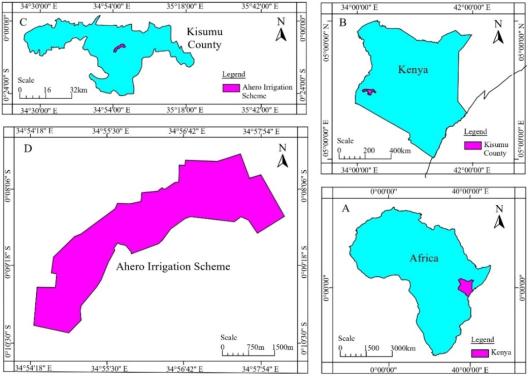
Figure 1. Geographical Location of Ahero Irrigation Scheme.
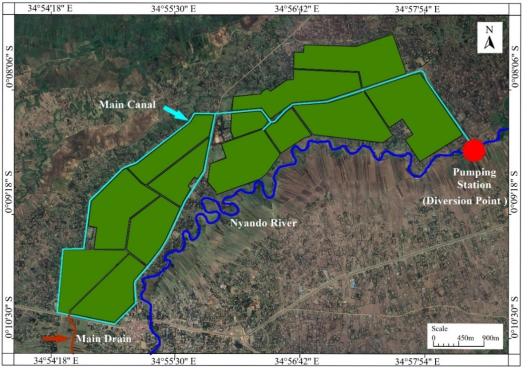
Figure 2. Arial Satellite Imagery of Ahero Irrigation Scheme (Source; Google Earth, 2025).
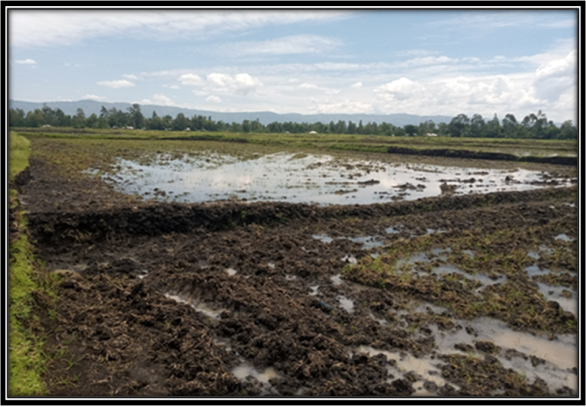
Figure 3. Unlevelled Irrigation Basin - Water Ponding at the Centre of the Basin while the Perimeter is Dry.
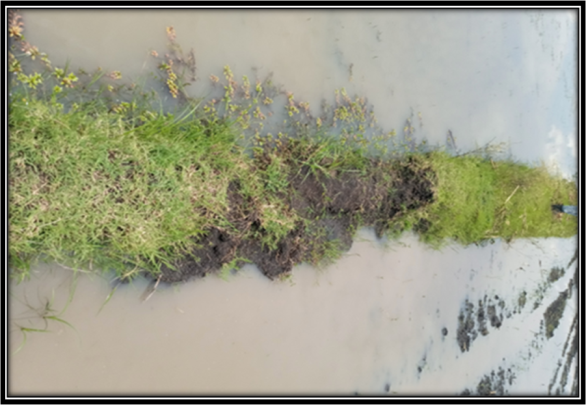
Figure 4. Broken Basin Bunds - The Bund Between the Two Basins is Thin and Collapsing.




 Share This Article
 Twitter
 Linked In
 Facebook
 Copy
Copy Download